Mari Wilson - Showpeople 1983

The €3 record that looked decades older than it sounded
This was one of those brocante purchases made on little more than instinct.
I had never heard of Mari Wilson, I was not even completely sure where she was from. The surname Wilson obviously did not sound particularly French, the sleeve had a big London logo on the front, and every track title was in English, so it felt like a reasonably safe punt at €3.
But the thing that really got me was the cover.
Mari is staring straight at the camera with an enormous beehive, gloves, jewellery and the sort of glamorous pose that made my brain jump everywhere except 1983. I was thinking Peggy Lee, Billie Holiday, Ella Fitzgerald, Judy Garland - somewhere between old Hollywood, torch songs, soul and a singer from the 1940s, 50s or 60s.
Then I put the needle down.
And 1983 exploded out of the speakers.
The opening track, Just What I Always Wanted, is an absolute banger. Deep bass, synths, drums, guitar, brass, or, as I described it while the record was actually playing, "pop-y pop, guitar, synth, drums, and brassy brass".
That contrast between the sleeve and the sound is probably the thing I will always remember about discovering this record.
The oldish French bloke standing his records upright
There was another reason I took the chance.
The seller was an older bloke with only a small number of records, but they looked as though somebody had actually cared about them. Showpeople was in a protective outer sleeve, and, one of my increasingly reliable brocante buying signals, he had the records standing upright.
Far too many sellers with ten old LPs chuck them flat in a pile.
This bloke did not.
I bought this, a Chris de Burgh album and the Grease soundtrack from him. Having now played Showpeople, I wish I had bought more.
The exact brocante has unfortunately vanished from memory, but what has not vanished is the feeling that this seller had looked after his records. This copy backs that up. The vinyl is visually EX, playback is EX and NM across 11 out of the 12 tracks, the outer sleeve is a very strong VG+ (my first highly scientific grade was "VG+++") and the original printed inner has survived in excellent shape too.
For €3, it was already looking like a good gamble before I had even heard the music.
The copy I had picked up was not the UK release either. It was the 1983 French edition on London, distributed by Barclay, with a slightly different track sequence from the British album. I did not know any of that while standing at the brocante, obviously, to me it was simply a strange-looking English-language record for €3.
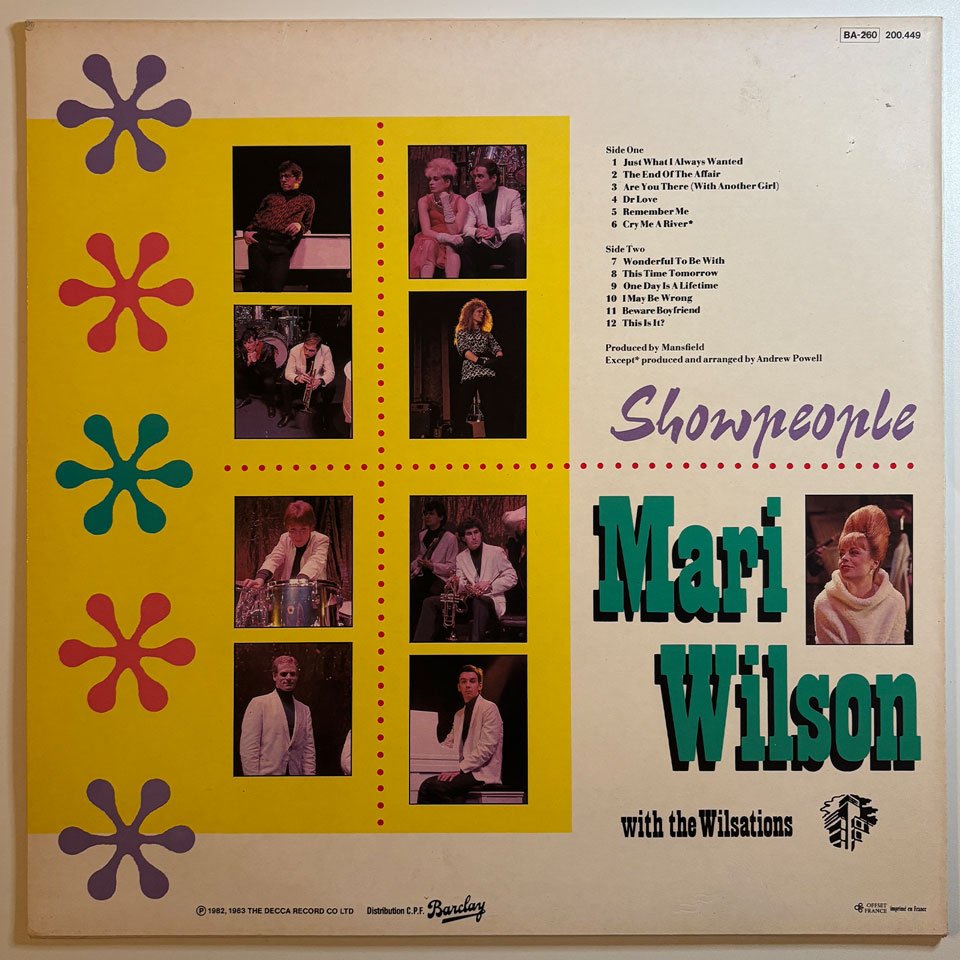
French Edition Rear Sleeve
Printed in France and distributed by Barclay, with the altered French track sequence visible here, the first physical clue that this was not the UK issue.
Retro on the outside, 1983 underneath
The strange thing is that the cover did not really lie to me, it just told me only half the story.
Mari Wilson's image was deliberately rooted in an older world. Contemporary coverage made plenty of the beehive and the 1960s styling, and Wilson has since talked about the old glamour that informed the look. At the same time, Tony Mansfield's production of Just What I Always Wanted deliberately put new-wave synths around that retro soul-pop idea, which is basically the contradiction I heard without knowing any of the background. Mari Wilson and Tot Taylor described that collision themselves in 2026.
That explains why the whole thing felt both instantly old and unmistakably 80s.
Showpeople was Mari Wilson's debut album, released in February 1983. It reached No. 24 on the UK Albums Chart, while Just What I Always Wanted had already reached the UK Top 10. Official Charts still lists the album's nine-week chart run and No. 24 peak.
I knew none of that when I bought it.
Which made the first listen considerably more fun.
An album that keeps changing shape
Side one is the more immediately poppy half on this French edition, and the sound is fantastic.
The bass is deep without swallowing everything else, the drums have proper weight, and synths make the decade obvious, but then brass, guitar, piano and strings keep arriving and giving the arrangements another dimension. It sounds polished, but not thin, with a lot going on.
That is what surprised me most, once I had come to terms this was in fact an 80s album.
I would expect an early-80s pop record to sound recognisably early 80s, but I had not expected it to sound this layered.
This Time Tomorrow was the track where that really hit me. It does not just settle into one mood and stay there. It moves through bright pop sections, then seems to drop into these deeper, more suspended passages before filling itself back up again.
My immediate reaction was that it sounded like a song of many parts and layers.
The best way I can describe it is that the arrangement occasionally pulls the floor out from underneath the pop song. The momentum drops, piano or rhythm suddenly has more space, then everything rebuilds.
Side two broadens out even further. There are more ballad-like passages, more piano, and then the album will suddenly throw itself straight back into full 80s pop again.
I May Be Wrong immediately made me think of ABBA, and I do not mean that I think somebody copied an ABBA song, it is more the combination of Mari's voice, the piano melody, the chord movement and the way the vocal keeps climbing until the section seems to open up above you.
Then (Beware) Boyfriend pushes straight back into bright pop again, except the brass gives the whole thing another layer.
It is one of those albums where I kept thinking “I know this sound, surely I have heard this before”.
Maybe some of it did drift past me as a child in the 80s, although more likely, the production is simply built from so many sounds that have since become shorthand for the decade that my brain recognises the language even when it does not know the song.
Mostly one songwriting world, with a couple of old standards hiding inside it
At first I wondered whether the familiarity came from the album being full of covers.
It is not.
Most of the songs are connected to Tot Taylor, who wrote much of Mari Wilson's material under the name Teddy Johns. Taylor himself explains the Teddy Johns identity in his own account of the music he made around Wilson and The Compact Organization. His site describes the Mari Wilson songs written under that name.
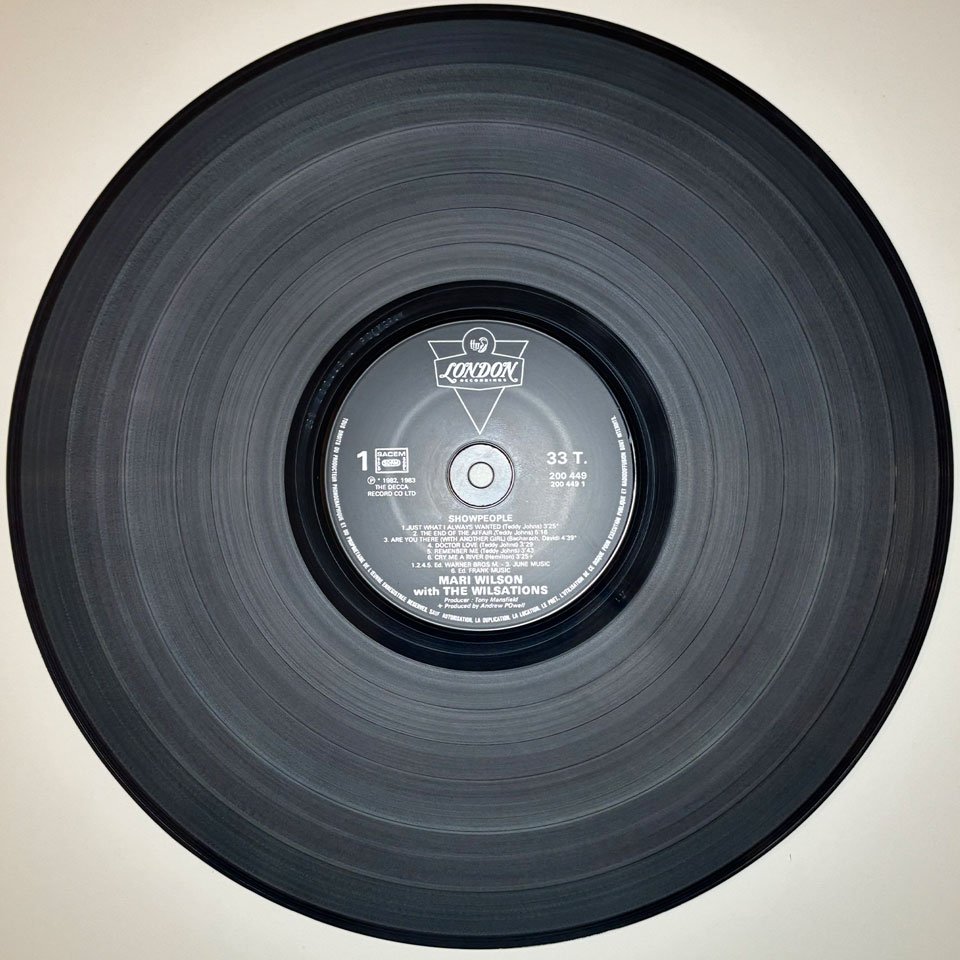
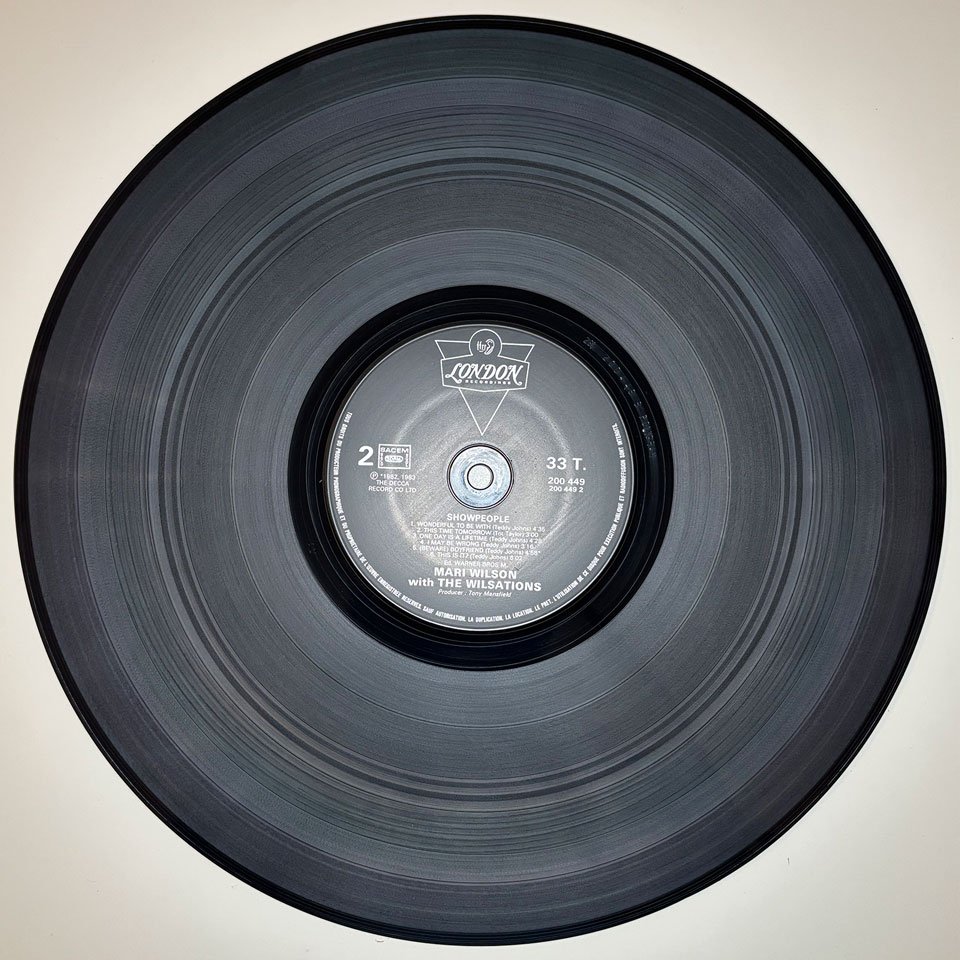
The labels on this copy make the pattern obvious. Most tracks are credited to Teddy Johns, while This Time Tomorrow is credited to Tot Taylor under his own name.
The two obvious older standards on my version are Are You There (With Another Girl) by Burt Bacharach and Hal David, and Arthur Hamilton's Cry Me a River.
That latter track gets its own production treatment too. The inner sleeve credits Tony Mansfield with producing the album except Cry Me a River, which was produced and arranged by Andrew Powell.
So this is not a random collection of old songs dressed up for the 80s, it is mostly one songwriter's world, interpreted through Mari Wilson and the Wilsations, with a couple of carefully chosen older songs sitting inside it.
That probably helps explain why the album remains so coherent even when the individual tracks keep changing style.
Not a concept album, but it definitely goes somewhere
By the final track I realised something else.
This is not a concept album, there is no story connecting track one to track twelve, and the songs do not all sound alike.
But, it still feels like a journey.
The album can move from outright pop into piano-led balladry, brass-heavy arrangements, retro soul, synth-pop and something almost theatrical, yet the songs still unmistakably belong together. There is a sound running through the whole thing that feels like Mari Wilson, rather than a dozen disconnected production ideas.
This Is It? makes a brilliant closer because it almost demonstrates the whole album in one song.
It starts inside the same pop world, then changes shape again with stop-start sections, piano and beat, another lift, and a repeating bass figure that sounded surprisingly modern to me. My brain briefly jumped decades forward towards later rock and pop, even something like Evanescence, not because the records are actually similar, but because that bass-driven section does not feel trapped in 1983.
Then the song closes with the line "I'm disappointed that this is it".
Which was funny, because by that point I was disappointed the album was over.
Trying to pick what I would immediately play again is almost pointless. Just What I Always Wanted is probably the clearest instant favourite, but then there is This Time Tomorrow, I May Be Wrong, partly because of that ABBA-ish lift, and This Is It?.
There are too many.
That is probably a better compliment than choosing one.
The inner sleeve is half the reason vinyl is brilliant
Then there is the physical record itself.
The outer sleeve is striking, but the original inner is where the package really opens up. Bright yellow, photographs everywhere, band members, credits, little design details, it suddenly feels less like something protecting the vinyl and more like another part of the album.
This is one of those moments where vinyl has something digital music simply cannot recreate in quite the same way.
You pull out what could have been a plain paper sleeve and discover another layer of personality.
And hidden among those credits is the line:
"Calendar photos ... Adrian Boot."
That sent me down another rabbit hole.
The UK album was definitely sold with a free calendar insert. A contemporary HMV advert for Showpeople explicitly says it "contains free calendar insert", while Mari Wilson later talked about the Adrian Boot shoot and its inspiration from Julie London's Calendar Girl. The 1983 advert survives in the NME archive, and Wilson later described the shoot and Julie London connection.
My copy has the calendar-photo credit on the original inner, but there is no calendar present.
The annoying bit, and the bit I am deliberately not pretending to know, is whether this French 200 449 edition was actually supplied with the calendar in the first place. I can verify it for the UK package, but I have not yet found equally solid evidence for this French version.
So for now the calendar is not "missing".
It is unresolved.
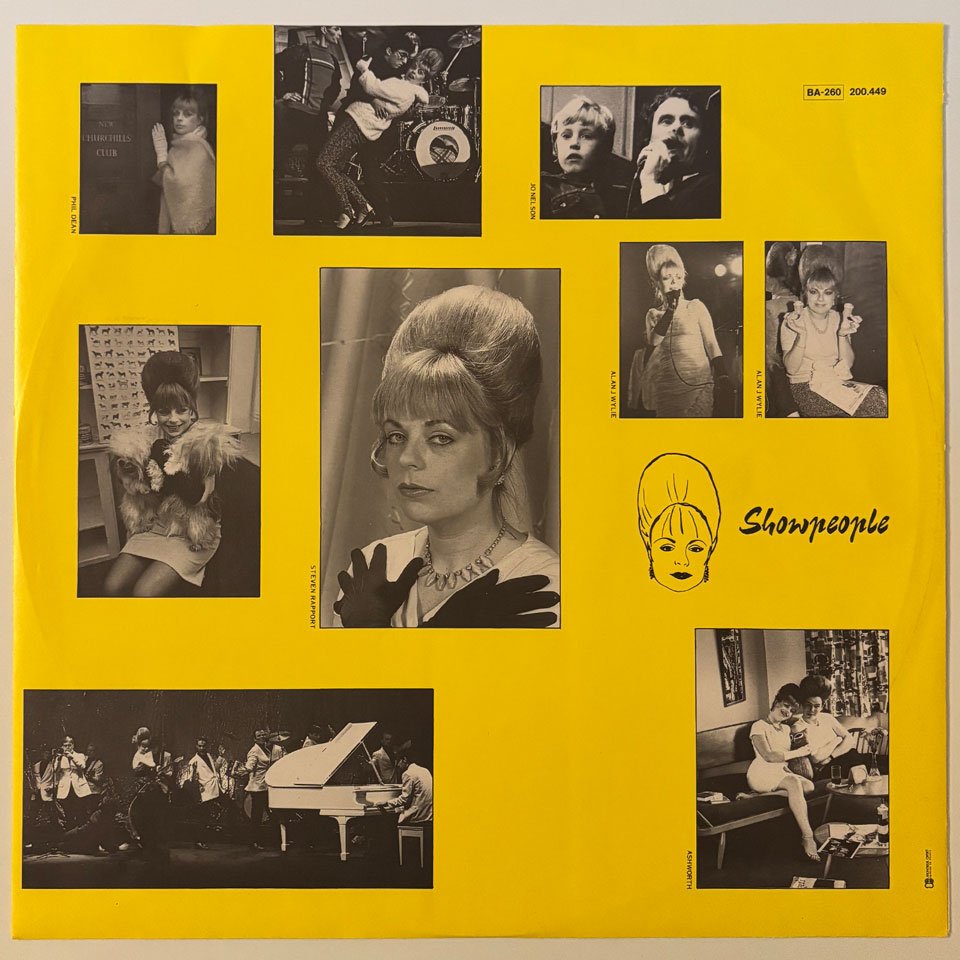
Original Inner Sleeve - Photo Side
The inner sleeve turns the packaging into part of the album itself, with a bright yellow collage of Mari Wilson photographs rather than a plain paper sleeve.
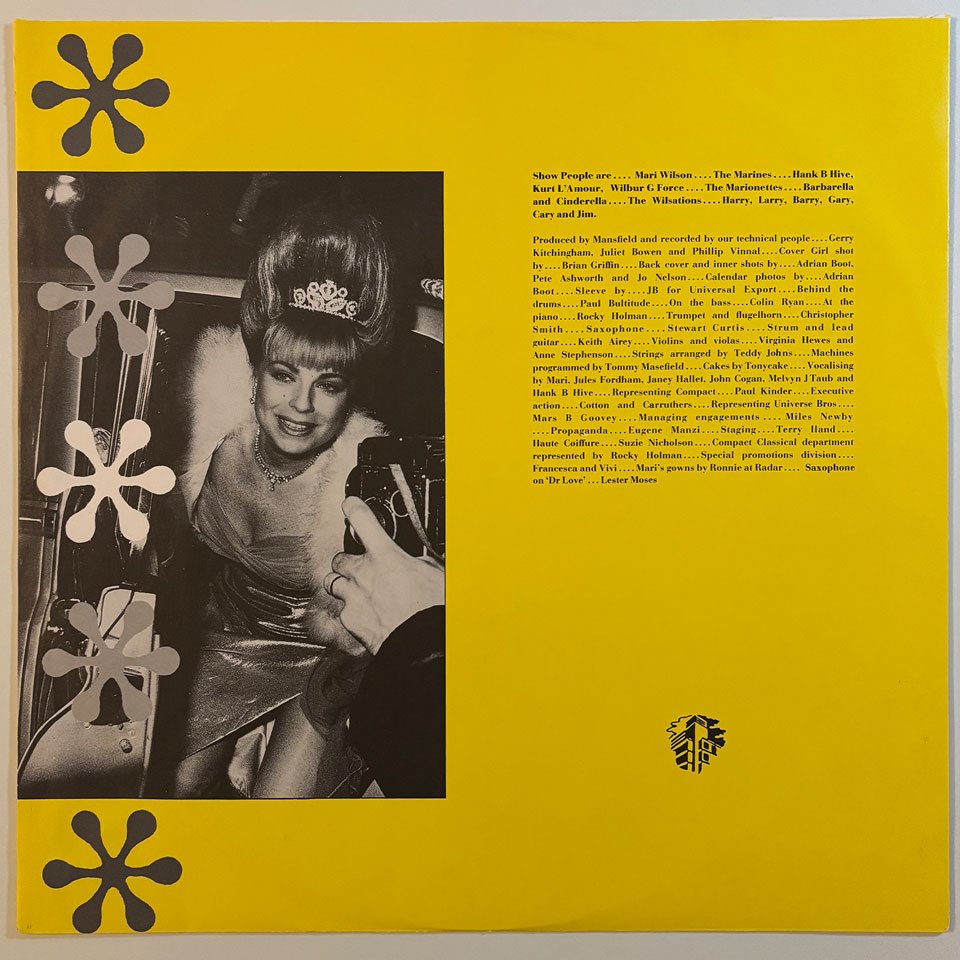
Original Inner Sleeve - Credits Side
The reverse carries the Wilsations and production credits, including the “Calendar photos … Adrian Boot” line that sent me into another rabbit hole.
A boring dead wax that still tells a story
The dead wax is not exactly rock-and-roll archaeology on this one.
There is no mysterious engineer's signature, no giant scratched-out matrix and no glorious argument with the internet.
But it does give this copy a clean manufacturing story.
Side A - observed on this copy
Stamped: 261 200449 A POLYGRAM
Separate small stamp: A1
Hand-etched / observed: none
Side B - observed on this copy
Stamped: 261 200449 B POLYGRAM
Separate small stamp: A1
Hand-etched / observed: none
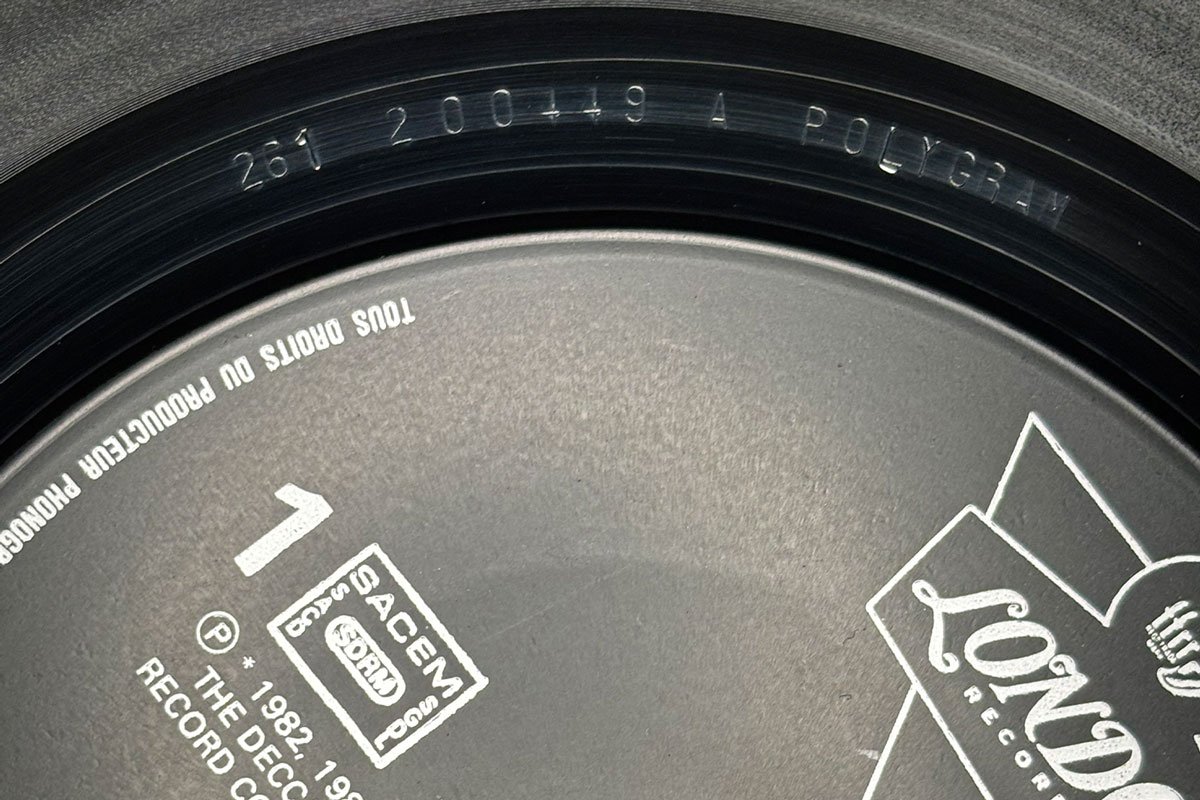
PolyGram Runout Stamp
The stamped 261 200449 A POLYGRAM supports French Polygram Industries Messageries manufacture, even though it does not identify the exact pressing plant.
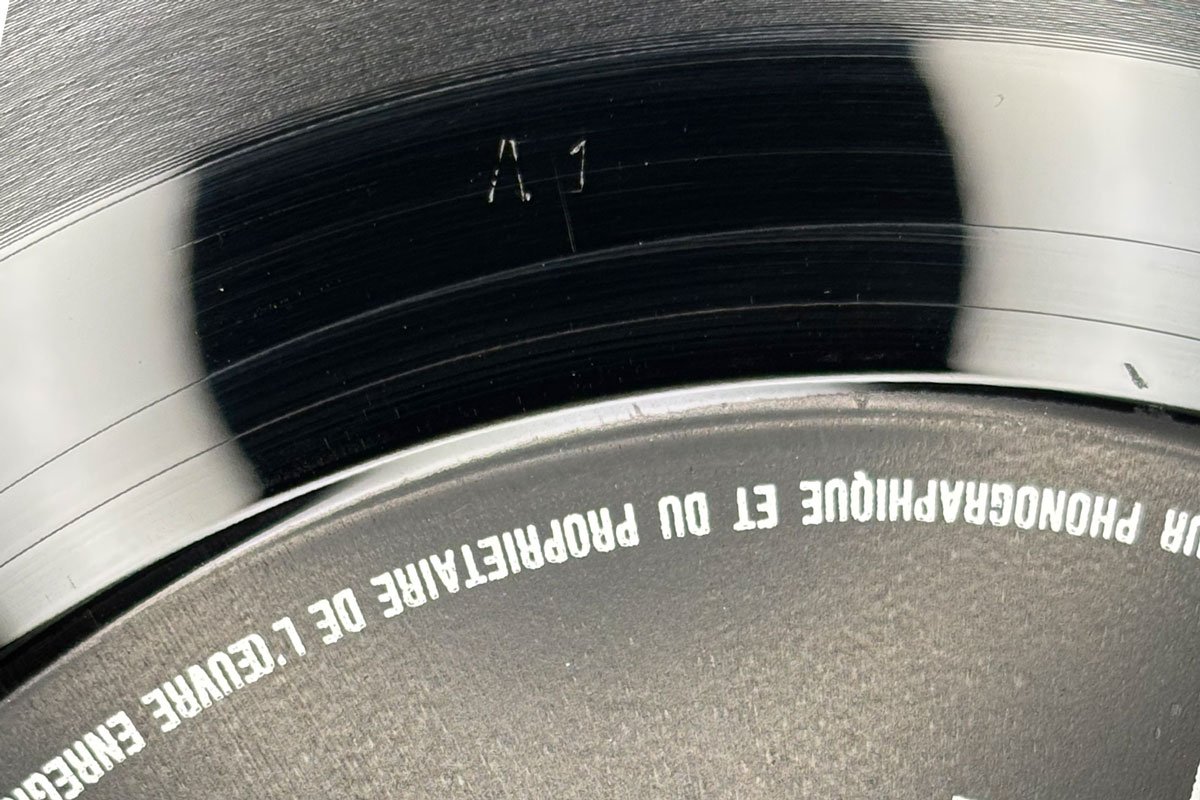
A1 Manufacturing Mark
A separate A1 stamp appears on both sides. It looks like a factory or metalwork identifier, but I have not found enough evidence to decode it any further.
The POLYGRAM stamp supports French manufacture by Polygram Industries Messageries, which operated the Louviers and Antony pressing facilities during this period. The surviving plant-identification information is quite clear about the limitation: for ordinary 12-inch records in this era, that company stamp does not reliably distinguish Louviers from Antony. The French PolyGram plant history documents that shared identity and the limits of the runout evidence.
So I know this is a French PolyGram-manufactured pressing.
I do not know which of those two plants physically pressed it.
There is also no identifiable cutting-engineer signature on my copy. The little A1 appears on both sides and looks like a factory production or metalwork identifier rather than somebody signing the lacquer. I have not found reliable documentation that decodes it any further, so it stays exactly what it is: observed, recorded, not over-interpreted.
That gives me a much cleaner production story than simply assuming France because the sleeve says imprimé en France:
UK artist and Decca-owned recording → French London release → French Polygram Industries Messageries manufacture → this physical copy.
Sometimes that is enough.
Record roulette in its glory
This record is exactly why I love buying things I do not know.
It was not a completely reckless gamble. The sleeve looked cared for, the seller looked like somebody who knew how to keep records, the London logo and English titles gave me enough clues, and at €3 there was not much at stake.
But I had never heard the album, and I had never heard of Mari Wilson.
I did not know the words, so nostalgia could not carry it. There was no moment where a familiar chorus arrived and rescued an average record because I remembered being twelve years old.
The music had to do all the work on its own.
And it did.
Showpeople is uplifting. I could dance to it, sing to it when I know the words, tidy up around the house to it, or simply sit and listen properly to everything happening inside the arrangements. It is polished, fun, strange in places, ridiculously catchy and far more varied than I expected a €3 record ever to be.
Even better, it has given me several new names to follow.
Tot Taylor. Tony Mansfield. Andrew Powell.
Then there are the Wilsations and the rest of the musicians tucked away in that brilliant inner sleeve. One unknown record has suddenly created several completely new routes into other records, productions and artists.
That is the other side of record roulette.
Sometimes you spend €3 and get something mildly interesting.
Sometimes you put the needle down and discover an artist you somehow missed entirely.
This was the second one.
Want to see more?