Various Artists - Sgt. Pepper's Lonely Hearts Club Band (Original Motion Picture Soundtrack) 1978

The £4 record I did not realise was a soundtrack
I found this album in a Sue Ryder charity shop in 2024, not long after getting the turntable and while my record-buying system was still extremely sophisticated (you can laugh out loud here) - do I recognise the artist, do I like the look of it, and is it cheap enough to take a chance?
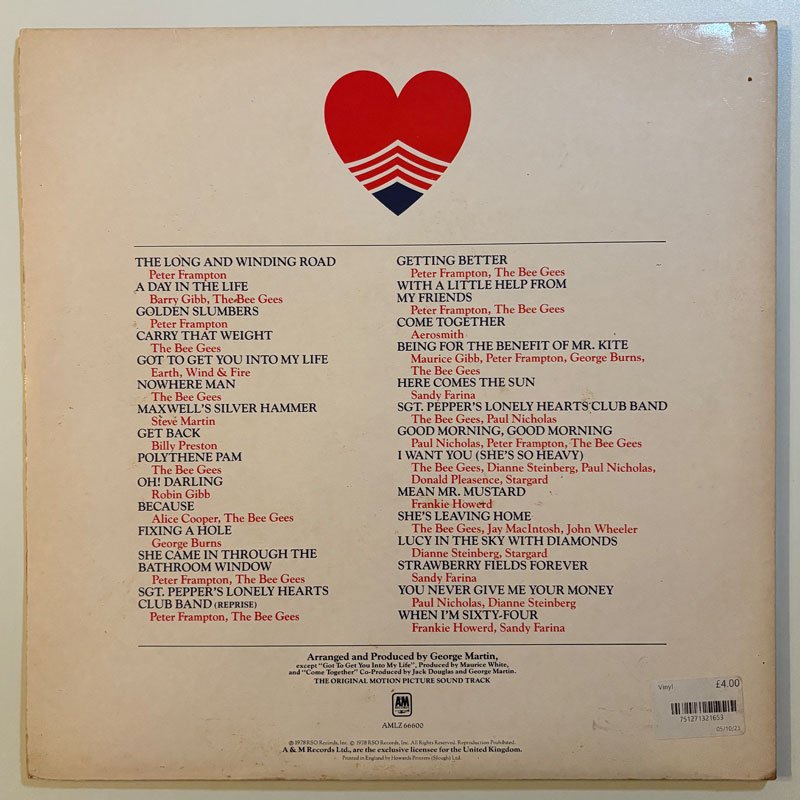
This ticked every box. The Beatles songs were familiar, the Bee Gees were familiar, Aerosmith were on there among a bunch of other names I recognised, including Steve Martin, the huge Sgt. Pepper's logo looked great, and it was £4. That was enough.
Somehow, despite the words Original Motion Picture Soundtrack being there if I had bothered to pay proper attention, did not really register until I got home. I had basically bought it because the cover shouted Beatles at me and the track listing looked ridiculous, in a good way.
And that accidental purchase is probably the perfect way for me to have discovered it. I had no reputation to get past, I did not know I was supposed to think the film was awful, I did not know the soundtrack had spent decades being treated as a cautionary tale, and I certainly did not know that George Martin had helped make the whole thing happen.
I just put the records on.
And I loved them.
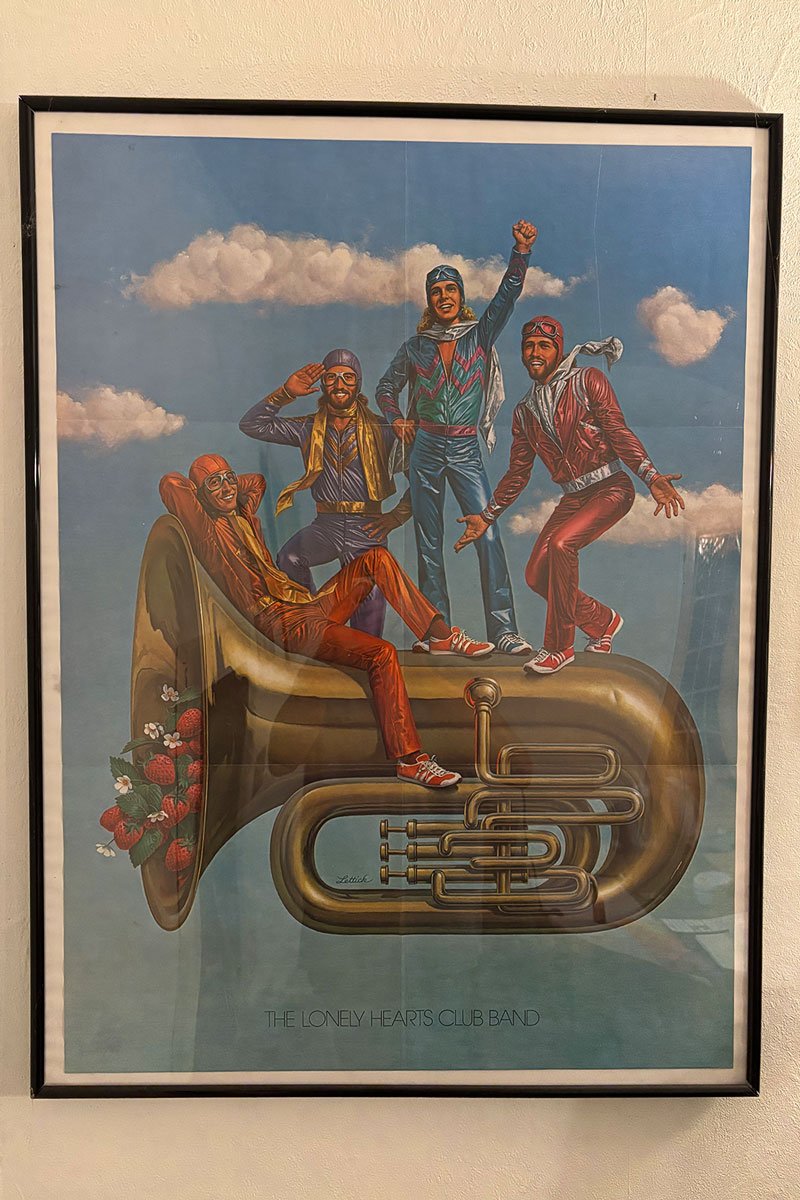
Movie Soundtrack Poster
The large original fold-out poster was still tucked inside the sleeve and remarkably well preserved. It now lives framed on my wall rather than folded away inside the record.
Familiar songs, but not the way I knew them
The first thing that struck me properly when I listened to all four sides again was how little this behaves like a normal tribute album.
The songs are obviously Beatles songs, but the soundtrack keeps changing its clothes, just like the emperor. There is glossy late-70s pop, disco, funk, soul, hard rock, comedy and full theatrical-musical excess, and certainly does not stay in one lane long enough to become background music. Even when I know exactly which song is coming next, it still has a way if surprising me and remembering that originally I did not know what sort of record it was going to become.
For me, that makes it a far more interesting listening experience, and in spite of that fact it has such a terrible critical reputation.
Steve Martin doing Maxwell's Silver Hammer may be the clearest example. On paper it sounds like the sort of thing that should make me remove the stylus immediately, but in reality, turning one of McCartney's darkest comic songs into an outright comedy-musical number somehow feels completely appropriate. It is absurd, but then the song is absurd when you think about it.
Aerosmith's Come Together is almost the opposite. Rather than turning the Beatles into theatre, they make the song sound like an Aerosmith song. The basic identity is still there, but the guitars are heavier, Steven Tyler sounds exactly like Steven Tyler, and the whole thing gains a dirtier, harder edge without losing what made the original work. A contemporary Washington Post review also picked Aerosmith's Come Together and Earth, Wind & Fire's Got to Get You Into My Life as the strongest performances, which was reassuring because they were two of the tracks that jumped out at me nearly fifty years later.
Earth, Wind & Fire's version goes even further away from a conventional cover. Got to Get You Into My Life was already one of the Beatles' brassier songs on Revolver, but here it becomes a full funk and soul performance. It did not merely survive the film either, as Maurice White later won a Grammy for the vocal arrangement on the track, something the Recording Academy still highlights in its biography of him.
The reputation of the film can make it easy to forget that some genuinely great records came out of this thing.
Sgt. Pepper's world, with the rest of the Beatles catalogue poured into it
I initially thought the soundtrack was essentially built from Sgt. Pepper's Lonely Hearts Club Band and Abbey Road, which is not completely wrong because those two albums loom very large over it. But the full soundtrack reaches further across the Beatles catalogue.
A 1978 review of the soundtrack pointed out that only ten of the 28 songs on the two records actually came from the original Sgt. Pepper album. Abbey Road supplies a huge amount of material, including Come Together, Maxwell's Silver Hammer, Oh! Darling, I Want You (She's So Heavy), Here Comes the Sun, Because, You Never Give Me Your Money, Mean Mr. Mustard, Polythene Pam, She Came In Through the Bathroom Window, Golden Slumbers and Carry That Weight. The Beatles' own site shows just how much of Abbey Road's second side was lifted into the film's musical world.
Elsewhere, Got to Get You Into My Life comes from Revolver, Nowhere Man from Rubber Soul, while The Long and Winding Road and Get Back belong to Let It Be. Then there is Strawberry Fields Forever, which sits outside the core studio albums altogether.
So the clever bit is not really that they adapted the Sgt. Pepper album.
They adapted the idea of it.
The fictional band becomes an actual fictional band. Billy Shears becomes an actual character. Sgt. Pepper becomes part of the mythology. Characters and images from Beatles songs are pulled out of the lyrics and made literal. The Sgt. Pepper concept provides the theatrical world, and then the wider Beatles catalogue is poured into it.
And then the film makes everything even stranger
Listening to the soundtrack without the film is one thing. Watching the film afterwards changes it completely.
The Bee Gees are Sgt. Pepper's Lonely Hearts Club Band, Peter Frampton is Billy Shears, George Burns is narrating, Steve Martin appears as Maxwell, and Aerosmith turn up as villains. Beatles lyrics stop being lyrics and start becoming plot points.
It is absolutely bonkers.
The ridiculousness was not an accident. According to the AFI's production history, Robert Stigwood first produced an off-Broadway Beatles musical in 1974 before developing the idea into the film. The project was conceived as a large-scale musical, and Stigwood was already operating in the same extraordinary period that produced Saturday Night Fever and Grease.
That context matters because the film makes more sense when you stop asking why it is not behaving like a Beatles film and start treating it as a late-70s Hollywood musical built out of Beatles songs. Something the critics could have perhaps considered in their write-ups.
The original Beatles films have their own humour, looseness and quintessential British personality. This is something completely different, it’s bigger, glossier, more literal, more commercial, and far more theatrical. Time Out's later review hated that literal approach, arguing that Beatles imagery, which worked as part of the 1960s songs, became awkward when physically turned into characters and plot.
I can see the criticism, but I can also see why I enjoy it.
I like cheese, I like romance, I like musical theatre, and I like something being completely committed to its own daft idea, so where somebody who lived through the Beatles in real time might have watched this and thought somebody had taken something profound and turned it into shiny nonsense, I can watch it decades later as a cultural artefact from a completely different moment.
And that difference is probably the whole story.
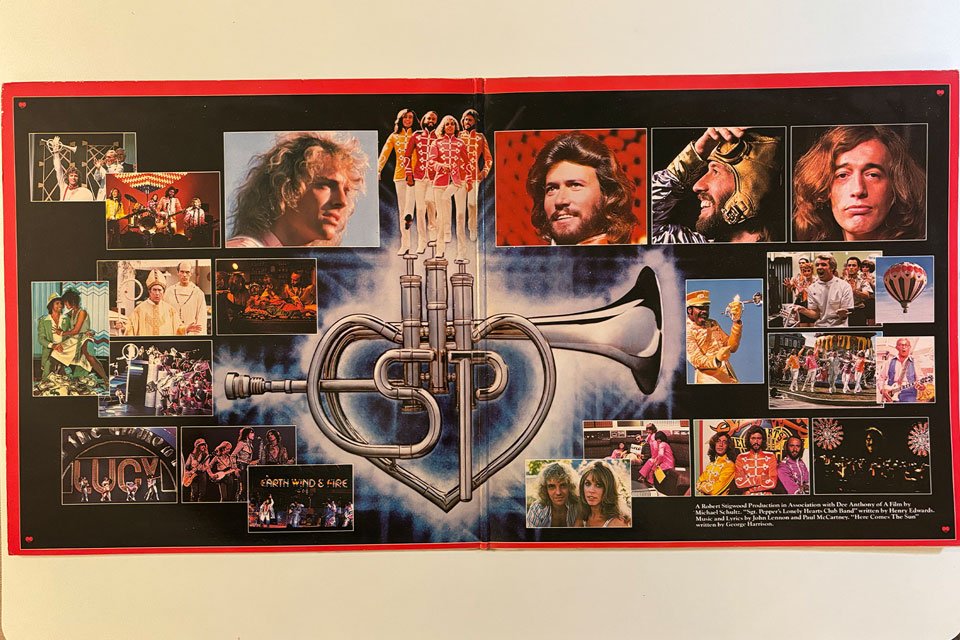
Outer Sleeve Gatefold
Opening the gatefold makes the scale of the whole project obvious, with film stills, cast portraits and artwork wrapped around that enormous brass-heart centrepiece.
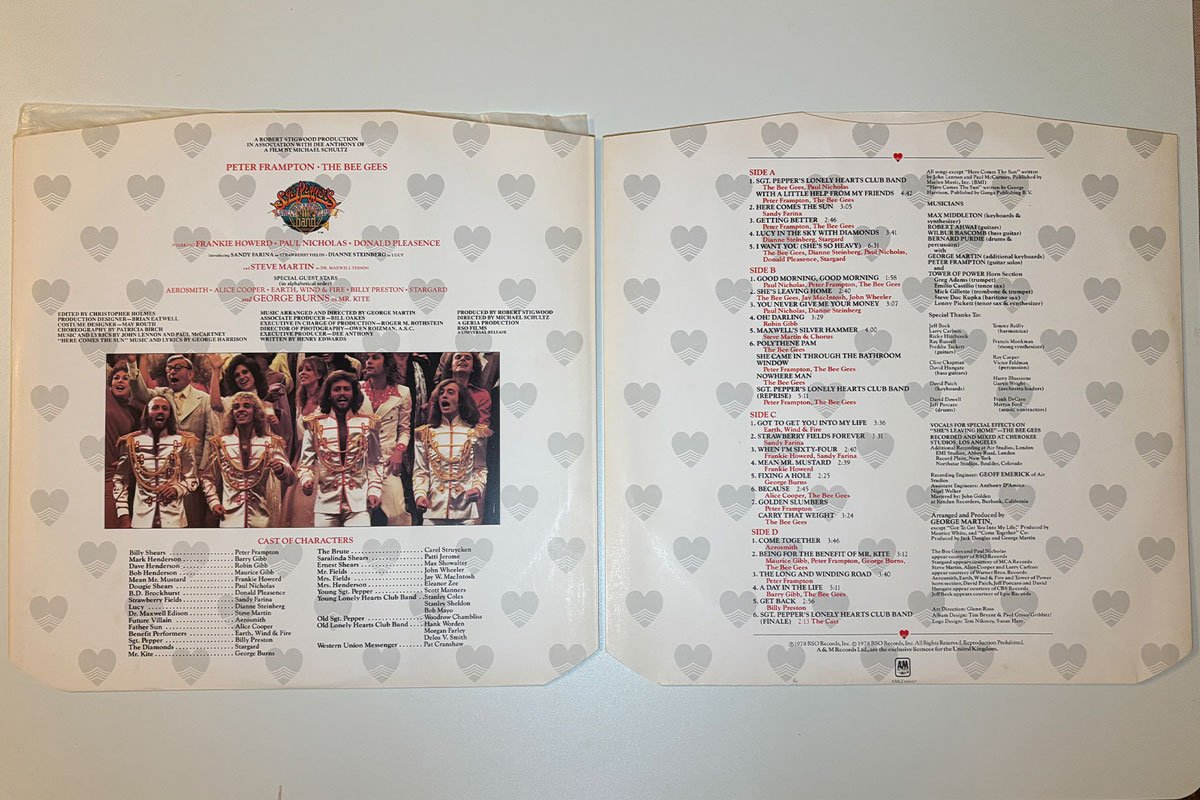
Inner Sleeves Front & Back
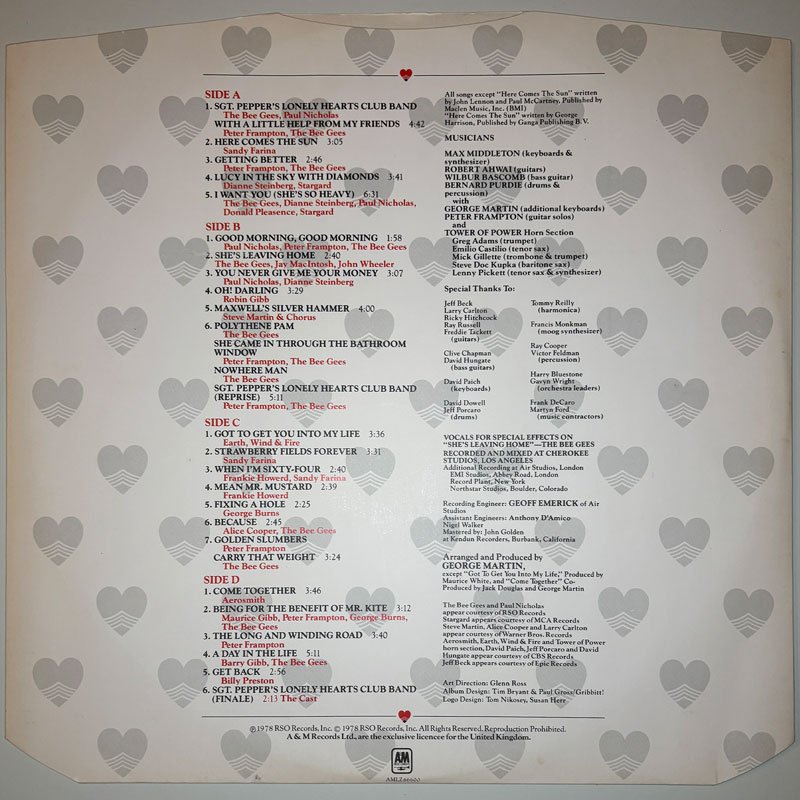
Both original printed inner sleeves survive with the set, carrying cast, track and production credits, including some of the details that sent me further down the recording and production rabbit hole.
When 1967 met the entertainment machine of 1978
The original Sgt. Pepper's Lonely Hearts Club Band is tied to one of the periods when the Beatles were using the studio as part of the instrument itself. Psychedelia, orchestration, sound effects, unusual recording techniques, and the freedom of pretending, briefly, to be another band.
Then eleven years later, those songs and characters are being filtered through Robert Stigwood, Hollywood, disco-era pop culture, enormous sets, and a cast of late-70s stars.
It is tempting to reduce that to "American pop culture ruined the Beatles", but the real story is messier and more interesting than that.
For a start, George Martin was heavily involved, the same producer who had been central to the Beatles' recorded sound, arranged and principally produced this soundtrack. The two performances that feel most obviously different from the George Martin-led material are also the two widely regarded as standouts - Got to Get You Into My Life was produced by Maurice White, while Come Together was co-produced by Jack Douglas and George Martin. Those exceptions are printed on this copy's inner sleeve.
The rights story is also not simply a case of the Beatles signing to a record label and somebody else taking their songs. The AFI's account of the production deal says Stigwood acquired rights to use 29 Beatles songs, and contemporary reporting cited there says Lennon and McCartney were paid $500,000 plus a percentage of the film's gross, with conditions around approval and preserving the melodies and lyrics.
That makes the film less like an unauthorised raid on the catalogue and more like a very expensive, officially licensed act of late-70s excess.
Which somehow makes it even funnier.
The Beatles reaction is less simple than the legend
One of the stories that tends to follow the film around is that "the Beatles hated it", although I think that is too neat, and a little convenient for the critics.
George Harrison was definitely not impressed with the wisdom of the project, and in a 1979 interview, later republished by Rolling Stone India, he said he felt sorry for Stigwood, the Bee Gees and Peter Frampton for doing it and thought it had damaged their images. His clearest comparison was "It's just like the Beatles trying to do the Rolling Stones. The Rolling Stones can do it better."
That is a much more accurate use of criticism than simply saying the songs had been ruined. He was questioning why successful artists with their own identities needed to dress themselves up as somebody else.
Peter Frampton's own memories make the whole episode even more extraordinary. Looking back decades later, he told Louder that he realised on his first day of filming that taking the role had been a mistake, and that one reason he had agreed was because he had been led to believe Paul McCartney would be involved.
So even some of the people inside it all seem to have realised they were in very strange territory.
That does not make me enjoy the soundtrack less, if anything, it adds another layer to it.
The critics hated it. I had a brilliant time
There is no point pretending the contemporary reception was misunderstood genius all round, plenty of critics thought the whole project reduced the Beatles to commercial caricature. The Washington Post's soundtrack review complained about the songs being polished and sweetened for mass consumption, while later reviews have repeatedly treated the film as one of those spectacular ideas that should probably have remained an idea.
But there were dissenting voices even then, and the music itself never fitted neatly into the disaster narrative. Earth, Wind & Fire's performance earned Grammy recognition, Aerosmith's version of Come Together survived independently of the film, and the very tracks critics tended to praise in 1978 are still the ones that sound strongest to me now.
That is what makes this record work for me.
I am not listening to this in 1978 with the original Beatles records still feeling recent and culturally untouchable, I found it in a charity shop almost fifty years later. Yes I already knew the originals and already liked most of the artists, but I had no emotional investment in whether the film treated the Beatles with the correct level of reverence.
I could just listen to what was actually in the grooves.
And as a four-sided listening experience goes, I think it is brilliant fun. It moves, it changes, it surprises me, it is occasionally ridiculous, and often beautifully played. The few tiny pops on this copy are almost the only reminder that I am listening to a record that is approaching fifty years old.
That alone would have made it a good £4 purchase.
Then I looked at the dead wax.
When my £4 charity-shop record disagreed with the internet
This is where the story stopped simply being about the soundtrack and became a story about this particular physical copy.
The UK release is catalogue number AMLZ 66600, issued as a double LP with the embossed gatefold, two printed inner sleeves and a large poster, and my copy still had all of it. The poster looked as though it had hardly been opened and is now framed on my wall.
The vinyl itself looked astonishingly clean. Under strong light there are a few small scuffs and hairlines, so I have graded both records EX visually rather than getting carried away and calling shiny vinyl NM. After playing all four sides, the playback grade is also EX. I counted roughly three tiny isolated pops across the whole double album, none distracting, and some may disappear completely once the records have had a proper clean and antistatic treatment.
But the really interesting bit is the runout.
A commonly documented UK variant is listed with an A3 / B2 / C3 / D4 cut sequence. My copy physically reads:
A3 / B3 / C4 / D4.
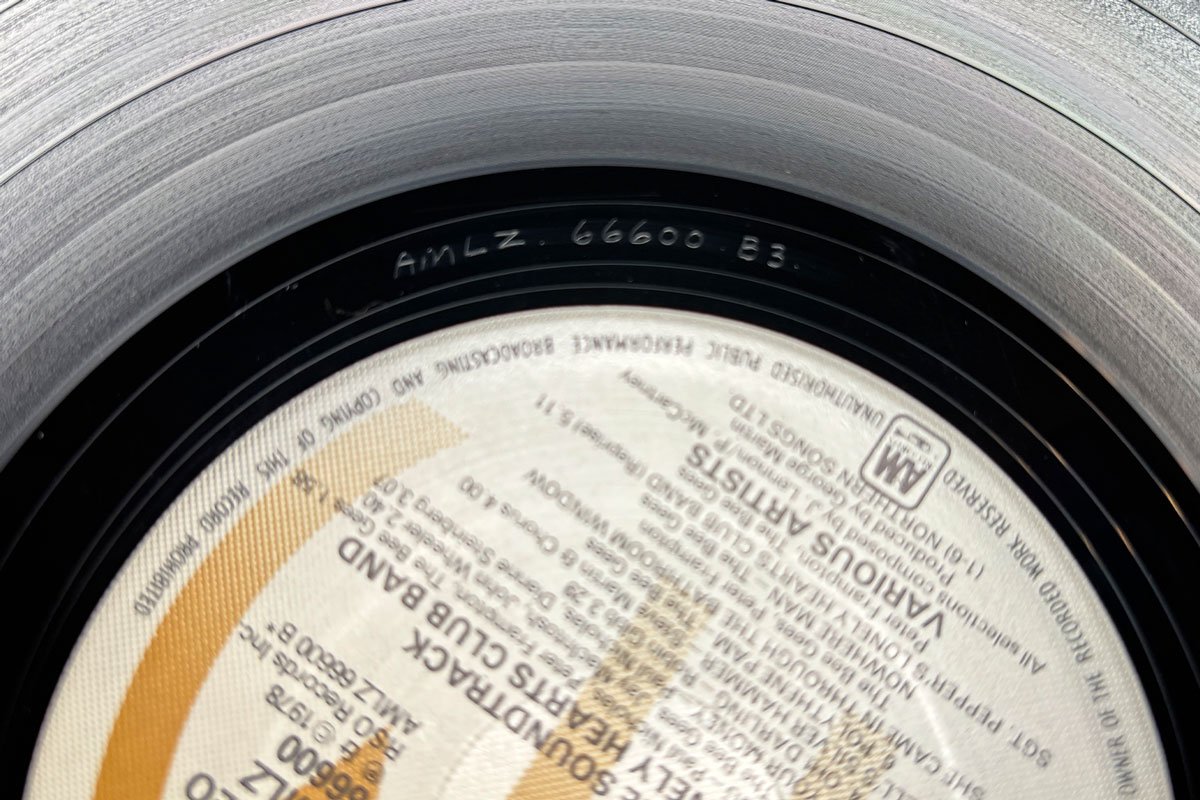
Record One, Side B
AMLZ. 66600. B3 - differing from the commonly documented B2 cut.

Record Two, Side C
AMLZ. 66600. C-4 - differing from the commonly documented C3 cut.
And this isn’t me misreading a faint number under bad light. The B3 and C4 are now photographed clearly enough that I am happy putting them online and letting anybody else look for themselves.
This is exactly the kind of thing I never expected when I started buying records. The internet is enormously useful, but the record in my hand is still the primary evidence. If the physical copy says B3, I am not changing it to B2 because that is what a database expects to see.
Four sides, two cutting engineers and one unresolved little mystery
The first record carries the hand-etched signature tone on both sides. That signature is associated with UK cutting engineer Tony Bridge, who worked at Pye Studios during this period.
Record Two becomes more interesting again. Side C carries a stylised hand-etched MBπ signature alongside the C4 matrix. That mark is strongly associated with Mike Brown, another cutting engineer who worked at Pye. Contemporary UK examples use the same MBπ mark, so the attribution is strongly supported, even though I do not have an original production sheet saying "Mike Brown cut this exact C4 lacquer".
That distinction matters. The record gives me the mark while external research helps interpret the it. I do not want to turn a good inference into a fake certainty.
The likely production chain for the UK copy therefore becomes quite interesting. The soundtrack itself was mastered by John Golden at Kendun Recorders in California, according to the printed credits. The UK lacquers then appear to have been cut separately, with Tony Bridge responsible for the A3 and B3 sides and Mike Brown strongly indicated on C4. Side D is clearly D4, but its faint extra hand marking is still not clean enough for me to assign a cutter with the same confidence, although it does look like Mike Browns MBπ.
The pressing plant is another step I am leaving unresolved. Similar UK A&M records cut by Bridge and Brown were pressed at CBS Aston Clinton, and some of the impressed marks on this copy are compatible with that system, but I have not found enough evidence to state Aston Clinton as fact for this particular copy.
That is staying in the "likely" pile rather than the "verified" pile.
Deadwax / runout transcription
These are the markings observed on the physical copy. The main matrices and cutter signatures are hand-etched unless noted otherwise.
Record One - Side A
Stamped / impressed: no confidently transcribed plant mark.
Hand-etched / observed: AMLZ. 66600. A3 + tone
Record One - Side B
Stamped / impressed: no confidently transcribed plant mark.
Hand-etched / observed: AMLZ. 66600. B3 + tone
Record Two - Side C
Stamped / impressed: a separate small impressed mark is present but not confidently transcribed.
Hand-etched / observed: AMLZ. 66600. C-4 + MBπ
Record Two - Side D
Stamped / impressed: no confidently transcribed plant mark.
Hand-etched / observed: AMLZ. 66600. D4 + faint additional hand marking(s), not yet legible enough to transcribe confidently.
The important comparison is that the commonly documented UK set is A3 / B2 / C3 / D4, while this physical copy is A3 / B3 / C4 / D4. Until another copy or archival source explains the sequence, I am treating mine as an apparently undocumented or less commonly documented UK cut combination rather than trying to force it into an existing listing.
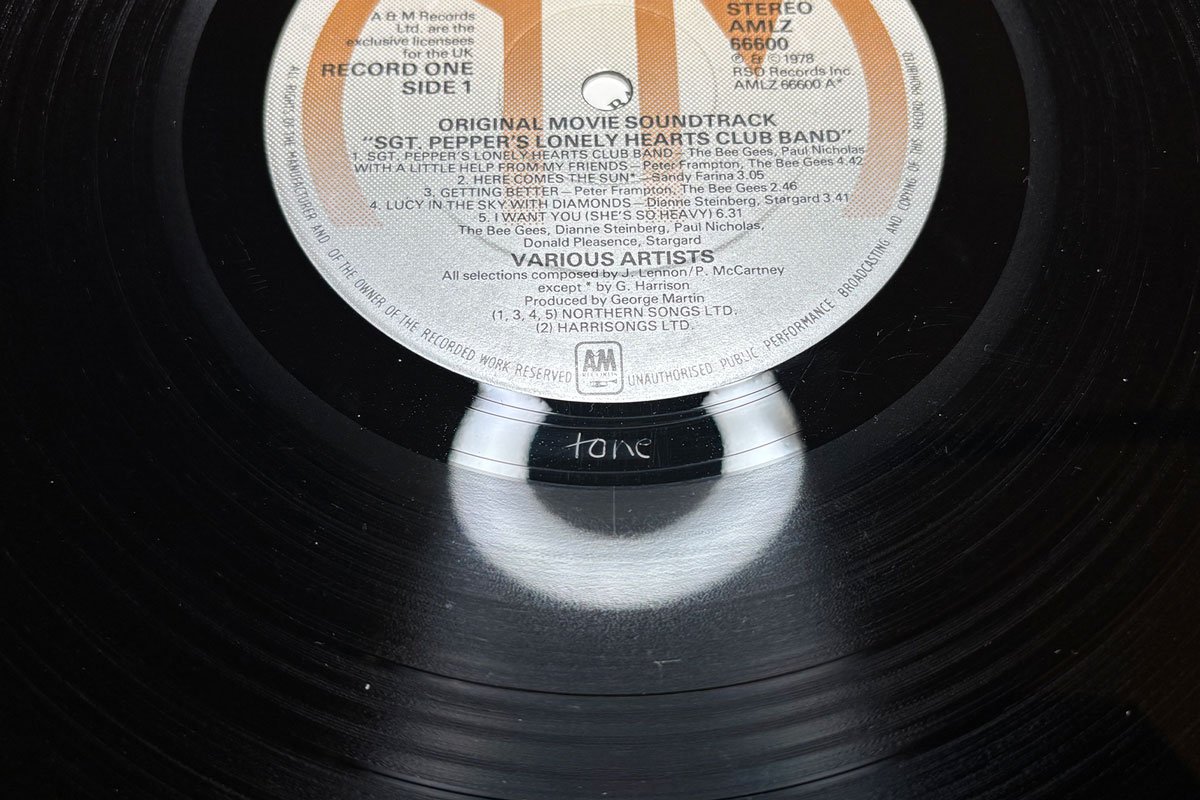
Tony Bridge - tone
Hand-etched tone signature on Record One. The mark is associated with UK cutting engineer Tony Bridge, who worked at Pye Studios during this period.

Mike Brown - MBπ
Hand-etched MBπ signature on Record Two, Side C. The mark is strongly associated with cutting engineer Mike Brown, also working at Pye Studios at the time.
Why this record now means more than the £4 I paid for it
I bought this because I recognised some names.
That was genuinely it.
Now it has become one of the records that explains why I enjoy collecting physical music in the first place.
There is the obvious bit, I like the music. The soundtrack is fun, varied, theatrical, and much better to my ears than its reputation would have prepared me for. Then there is the film, which is so committed to being a gigantic late-70s Beatles fantasy that I cannot help enjoying the madness of it. Then there is the history around it. Stigwood, George Martin, the Bee Gees, Frampton, Aerosmith, Earth, Wind & Fire, Steve Martin, and an entire Hollywood production trying to translate Beatles mythology into the language of a 1978 musical.
And then there is this particular copy.
The embossed sleeve has aged, the outer is slightly grubby and discoloured in places, although the two printed inners have survived much better, the poster somehow stayed with it for nearly five decades and now lives on my wall, the records themselves play absurdly well, and scratched into the dead wax are a couple of tiny numbers and signatures that turned a charity-shop purchase into a manufacturing investigation.
That is probably the thing I like most about it.
The soundtrack itself is a timestamp, it is a moment when 1960s Beatles culture collided with 1970s Hollywood, disco, arena rock, musical theatre, and the confidence of an entertainment industry that apparently believed it could turn almost anything into an event.
I completely understand why somebody could hate it.
Unfortunately for the critics, I listened to all four sides and had a brilliant time.
Want to see more?