The Merseybeats - Greatest Hits 1977

I thought I was buying a Liverpool compilation
There is something wonderfully dangerous about buying records you know absolutely nothing about.
I found this one in a charity shop with a Cancer Research UK sticker still sitting in the corner: £1.95. The cover said Merseybeats Greatest Hits, there was a drawing of the Liverpool skyline across the front, and my brain immediately filled in the blanks.
Merseybeat. Liverpool. Sixties. Beatles.
Clearly, I thought, this must be some sort of compilation of bands from the Merseybeat scene.
For £1.95, why wouldn’t I?
Except that isn’t what I’d bought at all.
Apparently The Merseybeats are an actual band
This may be common knowledge to somebody who lived through the early 1960s, but I didn’t, so discovering that The Merseybeats were themselves one of Liverpool’s successful beat groups was my first little surprise.
According to The Merseybeats’ own history, Tony Crane and Billy Kinsley started playing together in Liverpool in 1961 as an Everly Brothers-influenced duo called The Mavericks. The group expanded, changed names and eventually became The Mersey Beats after getting permission from Bill Harry to use the name of his Mersey Beat newspaper. Later, it became the rather more familiar single word: The Merseybeats.
They weren’t simply hanging around the edges of the Liverpool scene either. Their official biography says they were regulars at the Cavern Club and appeared with The Beatles more often than any other band from that era.
And they had proper chart success. Official Charts records seven UK Top 40 singles: It’s Love That Really Counts reached number 24, Don’t Turn Around and Wishin’ and Hopin’ both reached 13, I Love You, Yes I Do reached 22, and their biggest Merseybeats hit, I Think of You, reached number 5. Their self-titled 1964 album reached number 12.
So my cheap little “Liverpool compilation” had already transformed into something much more interesting: an album by a genuine band from the scene I thought I was buying a compilation about.
Then I looked more closely at what the record actually was.
Greatest hits. Sort of.
Normally, when I see Greatest Hits on a record from the 1970s featuring a band whose success came mostly in the 1960s, I assume somebody has taken the old masters, put the familiar tracks together, designed a new sleeve and sent the thing off to the pressing plant.
Not here.
Printed on the back of my sleeve are the words:
RE-RECORDED IN STEREO 1977
That changes the whole thing.
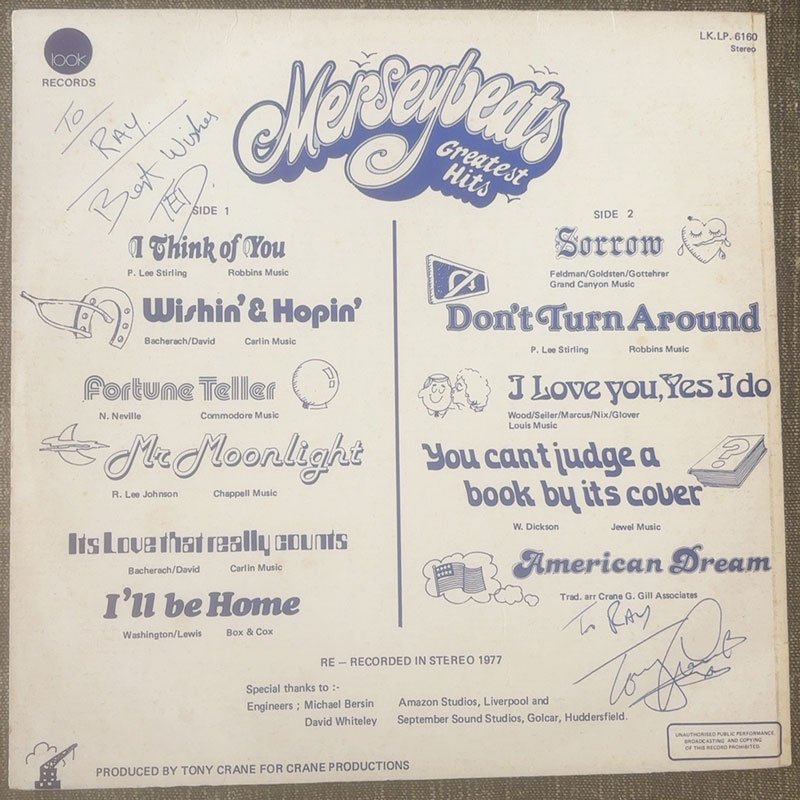
This isn’t simply a budget repackage of the original 1960s Merseybeats recordings. These are new 1977 recordings of songs associated with the band, produced by Tony Crane for Crane Productions. The sleeve also credits engineers Michael Bersin and David Whiteley and mentions Amazon Studios in Liverpool and September Sound Studios in Golcar, Huddersfield.
The release itself is independently documented as a 1977 UK Look Records LP, catalogue LKLP6160, with the same eleven tracks found on my copy. EIL’s listing for the album confirms the year, label, catalogue number, UK origin and track listing.
That also helps explain something about the way the record sounds. It doesn’t feel like somebody has opened a dusty archive and assembled a historical document. It feels like musicians revisiting songs they knew intimately and deciding how they wanted them to sound more than a decade later.
And those songs have travelled quite a distance themselves.
Eleven tracks and a ridiculous number of rabbit holes
One of my favourite things about this album is discovering how many of its songs weren’t born with The Merseybeats at all.
Wishin’ and Hopin’ is a Burt Bacharach and Hal David song, first recorded by Dionne Warwick before Dusty Springfield turned it into one of the best-known versions. The Merseybeats made it their own in 1964 and took it to number 13 in Britain, as Official Charts confirms.
Fortune Teller goes back to Benny Spellman in 1962 and was written by Allen Toussaint under his Naomi Neville pseudonym — which explains the N. Neville credit printed on my sleeve. It later passed through the hands of plenty of other artists, including The Rolling Stones, The Hollies and The Who.
Then there’s Mr Moonlight. Roy Lee Johnson wrote it, and Dr Feelgood and the Interns issued it in 1962. The Beatles later recorded their own version for Beatles for Sale; The Beatles’ own Anthology notes explicitly trace the song back to Dr Feelgood and the Interns. So a record I bought because I vaguely associated the word “Mersey” with The Beatles actually contains a song that connects straight back into The Beatles’ own early R&B repertoire.
I’ll Be Home travels even further back. The Flamingos recorded it in 1955, before Pat Boone turned it into a huge pop hit. His version spent five weeks at UK number one in 1956, something Official Charts still documents.
And then there is Sorrow.
The McCoys recorded it first in 1965. Tony Crane and Billy Kinsley subsequently recorded it as The Merseys, reaching number 4 in Britain. David Bowie then covered it for Pin Ups in 1973, and Bowie's own site describes his recording as his take on The Merseybeats’ version of the song originally released by The McCoys. Bowie took it to number 3.
So one song alone runs The McCoys → The Merseys → David Bowie → back onto this 1977 Merseybeats LP.
That is precisely the sort of nonsense I now enjoy disappearing into for far too long.
Even You Can’t Judge a Book by Its Cover gives this particular sleeve its own tiny mystery. The song was written by Willie Dixon and recorded by Bo Diddley in 1962. My sleeve, however, credits it to “W. Dickson”.
Probably a simple printing mistake.
But I like preserving things like that rather than quietly correcting them. My physical copy says Dickson. The documented song credit says Dixon. Both facts belong in its story.
American Dream — an Elvis discovery that goes back even further
This was probably my favourite musical discovery on the whole album.
An American Trilogy is one of my favourite Elvis tracks, so hearing the opening of American Dream immediately caused that little moment of recognition where your brain goes: hang on, I know this.
And then The Merseybeats take it somewhere slightly different.
The band’s own history lists American Dream as a Merseybeats single from 1975, and Tony Crane’s account identifies it as their take on Elvis Presley’s An American Trilogy, retitled American Dream. Hearing it here was one of those lovely discoveries that happens when you buy something without knowing exactly what is on it.
Except the lineage goes back another step again.
Elvis didn’t originate An American Trilogy either. Mickey Newbury assembled the medley from Dixie, All My Trials and The Battle Hymn of the Republic. Elvis’s official site says he became completely taken with Mickey Newbury’s An American Trilogy and started performing it himself, releasing his live version in 1972.
So what I’m actually listening to on this £1.95 charity-shop LP is another branch of a musical family tree:
traditional American songs → Mickey Newbury → Elvis Presley → Tony Crane and The Merseybeats → my turntable nearly fifty years later.
And I bloody love that.
It’s one of those accidental discoveries that makes buying unfamiliar records worthwhile. I didn’t go looking for an unusual version of one of my favourite Elvis performances; it just appeared at the end of Side Two.
Eargasm is probably an inelegant piece of music criticism, but I’m sticking with it.
The sleeve deserves some attention too
Before I’ve even got to the vinyl itself, there’s quite a lot going on with the physical object.
The artwork is wonderfully strange.
There’s a stylised Liverpool waterfront running across the sleeve, huge rounded seventies lettering, turquoise and navy colouring, little birds flying around the title and tiny cartoon illustrations scattered among the track names: a fortune teller’s crystal ball, the moon, a book, an American flag.
It feels like the seventies looking backwards at the sixties rather than trying to imitate it.
The track names almost become part of the artwork themselves, with the illustrations turning the whole thing into a slightly daft visual puzzle. It isn’t subtle, but I don’t think it is meant to be. For what could easily have been a boring budget greatest-hits sleeve, somebody clearly had fun with it.
And then I turned it over and discovered that somebody called Ray appears to have had rather better access to The Merseybeats than I ever will.
There are two handwritten dedications on the back.
The lower-right one is Tony Crane’s signature. I went away and compared it against known signed Merseybeats material and other Tony Crane autograph examples online, and I’m now comfortable treating that one as identified rather than merely “probably Tony”. There is plenty of surviving signed Merseybeats material out there — including examples catalogued by specialist memorabilia dealers and auction houses — which makes comparison possible.
The upper-left inscription is stranger. It reads “To Ray! Best Wishes TED” in large capitals. I went looking for an obvious Ted in the Merseybeats story and, so far, there isn’t one. The band’s own published family tree is actually rather revealing here: for the mid-to-late 1970s it acknowledges various line-ups and leaves gaps in the personnel record, while other attempts to reconstruct the 1974–83 period similarly list Tony Crane and Bob Packham with further members unknown. The Merseybeats’ official family tree therefore leaves open the possibility that “Ted” was a touring or cabaret-era musician, crew member or associate whose role simply wasn’t preserved properly online.
But that is still only a possibility. I haven’t found a reliable source naming a Ted as a documented Merseybeats member, and I’m not going to invent one to make the story tidier. For now, this copy has one signature I can identify and one that has become its own little research problem.
That is another thing I love about second-hand records. Somebody owned this before me. Somebody took it somewhere. Somebody apparently met somebody connected with the band. Eventually it ended up donated to Cancer Research, priced at £1.95 and picked up by an idiot who didn’t even realise The Merseybeats were a group.
That’s a decent little journey before I’ve even looked at how the record was manufactured.
And then the dead wax went weird
This is where the record became properly nerdy.
Side One and Side Two look as though they came from two different worlds.
Side One is hand etched:
LKLP 6160 A/3
and elsewhere in the runout is a separate:
RC
Side Two is machine stamped and considerably more complicated:
LKLP6160 B//3 ▽ E 420
with additional stamped 11 and 5 markings elsewhere around the runout.
That difference immediately raised the obvious question: why?
The answer starts with Look Records itself. Look Records was based in Huddersfield, established by George Parks and David Whiteley, and operated partly as a custom-recording business for club and cabaret artists as well as releasing records commercially. Importantly for this copy, the label is documented as using outside manufacturers including Phonodisc and Lyntone.
And Side Two is almost shouting Phonodisc at us.
The B//3 ▽ E 420 form matches the UK Philips/Polydor/Phonodisc family of runout markings. A detailed UK matrix-number guide explains that the number before the inverted triangle is the lacquer-cut sequence and that 420 is the code associated with Great Britain and Ireland. It also shows that labels outside the Philips/Polydor family that were pressed by Phonodisc often used the same style of runout legend.
So Side Two looks very much like a third lacquer cut made within the UK Phonodisc manufacturing system.
Then Side One gives us an actual person.
The separate hand-etched RC is associated with Ralph Copeman, a British mastering and lacquer-cutting engineer. His work is identified in runouts by those initials, and his documented work history places him at Phonodisc from 1971 to 1979. Ralph Copeman’s engineering history lines up perfectly with a record made in 1977.
Which potentially means that the scratches in the dead wax allow me to connect one side of this record to an actual human being who cut it nearly fifty years ago.
That’s ridiculous.
And brilliant.
Why are the two sides different?
This is where the evidence ends and the detective work begins.
The important thing I’ve learnt is that Side A and Side B of an LP do not have to travel through manufacturing together.
Each side needs its own lacquer. Each lacquer creates its own metalwork. Those two manufacturing lines can take different routes before the final Side A and Side B stampers eventually meet inside the record press.
That means a record can legitimately contain two sides with visibly different cutting or matrix histories.
The strongest current interpretation of my copy is that both sides reached a third cut independently, but Side One was cut or recut by Ralph Copeman and received a manually etched matrix, while Side Two retained the more conventional machine-stamped Phonodisc legend.
Why?
That’s the bit I can’t prove.
Maybe an earlier Side A lacquer failed quality control. Maybe metalwork was damaged or exhausted. Maybe another stamper was needed. Maybe it was simply production scheduling and Copeman happened to handle a replacement cut.
There may once have been a piece of paperwork somewhere in Walthamstow that explained the whole thing perfectly.
If there was, the internet hasn’t coughed it up yet.
And that’s fine.
Part of the fun of this is knowing where evidence stops and speculation begins. The physical copy tells me what is actually there. The manufacturing references tell me what those marks are consistent with. The precise reason why this copy ended up with such different-looking sides remains an inference rather than something I’m going to pretend I know.
But does it actually sound any good?
Thankfully, after spending far too much time staring at tiny scratches in an area of the record that contains precisely no music, I did eventually remember to play the bloody thing.
Visually, the vinyl is VG+. There are signs that it has been handled and played, but nothing remotely alarming. The sleeve is also VG+: genuinely very presentable considering its age, even with the charity-shop sticker and handwritten dedications that are now part of this particular copy’s history rather than things I’d want to remove.
Playback?
I’d comfortably give it NM.
There are no meaningful playback issues at all. No distracting crackle, no pops fighting with the music, no obvious groove damage announcing itself every rotation. For a charity-shop record that cost less than some cups of coffee, it sounds superb.
More importantly, I really enjoy it.
There is something about the sound of these recordings that transports me. I’ve never sat inside the Cavern Club listening to The Merseybeats in the early sixties — for fairly obvious chronological reasons — so I’m not going to pretend this is some authentic memory.
But it sounds like my idea of it.
A small room. A band playing tightly together. Harmonies bouncing around the walls. Songs arriving from America and elsewhere and being absorbed into that particular Liverpool sound before being sent back out sounding slightly different.
That’s probably what I enjoy most about the album.
The Merseybeats aren’t simply reproducing Wishin’ and Hopin’, Fortune Teller, Mr Moonlight or You Can’t Judge a Book by Its Cover. They’re filtering them through themselves.
They’re effectively saying: this is how we think this song should sound.
And because these are 1977 re-recordings, they’re doing it again years later — revisiting music that had already helped define them once.
Then American Dream arrives and gives me that completely unexpected connection to one of my favourite Elvis performances. Hearing a song I already loved reflected back through The Merseybeats’ own sound was a beautiful little discovery, and probably the moment that sealed the album for me.
Not bad for £1.95
I bought Greatest Hits because I misunderstood its title.
I thought I was buying a compilation of Liverpool beat groups because I liked The Beatles and fancied hearing a bit more of that world.
Instead I discovered The Merseybeats themselves, their relationship with the Cavern era, eleven songs with histories stretching through American R&B, Bacharach and David, Bo Diddley, Bowie, The Beatles and Elvis, a wonderfully odd 1970s sleeve, two mysterious signatures, fresh stereo recordings of old hits, and a pressing whose two sides appear to have taken different journeys through Phonodisc before meeting in the same piece of vinyl.
And at the end of Side Two, I got a version of one of my favourite Elvis-associated songs that I didn’t even know existed.
This is exactly why I love buying records I know nothing about.
Sometimes you spend £1.95 and get eleven songs.
Sometimes you spend £1.95 and get a rabbit hole.
Want to see more?